
Are you starting your college research for the 2026-27 academic cycle? If you are relying on five-year-old rankings or outdated brochures to predict your MBA placements 2026, you might be setting yourself up for a rude awakening upon graduation.
The corporate hiring landscape has undergone a monumental shift. According to the GMAC Corporate Recruiters Survey 2026, while the demand for MBA graduates remains highly robust—with over 37% of employers planning to increase their MBA headcount—the type of candidate they want has fundamentally changed. Recruiters are no longer handing out premium packages for legacy brand names alone. Instead, they are hiring for capabilities, adaptability, and technology-fluent judgment.
If you want to secure a high-paying, future-proof role, your strategy must target business schools that actively adapt to these modern patterns. Here is your comprehensive guide to the hiring shifts impacting MBA placements 2026 and how to align your B-school shortlist with the demands of the modern workforce.
The AI Baseline: How Technology is Rewriting MBA Placements 2026
For years, “AI and Machine Learning” were specialized electives reserved for tech-heavy programs. Today, AI fluency has officially become a non-negotiable baseline.
According to major employer studies, 22% of hiring managers now view AI proficiency as a basic expectation for all MBA-level roles, not a differentiator. If you focus on campuses where “Digital Transformation” is just a buzzword, your prospects for top-tier MBA placements 2026 will be severely limited.
The Shift in Key Disciplines:
- Finance & Investment Banking: Routine financial modeling, data aggregation, and risk reports are increasingly automated. Modern recruiters want MBA finance graduates who can use AI to identify market anomalies and draft complex investment strategies.
- Marketing & Brand Management: Basic copywriting and A/B testing are largely automated. Top-tier FMCG and e-commerce companies now seek marketing managers who can orchestrate AI-led consumer insight campaigns and interpret multi-channel data.
- Consulting & Strategy: Strategy is no longer a separate, textbook-based skillset. Consulting firms expect new hires to utilize advanced analytical and AI research tools to solve client problems at double the speed of previous generations.
The Rise of Specialized Management Roles: This technology-driven shift has created a massive surge in specialized,tech-integrated management roles that dominate modern placement drives:
| Job Role | Impact of 2026 AI Trends | Growth Sectors |
|---|---|---|
| AI Product Manager | Bridges the gap between tech developers and business goals. | Tech, SaaS, E-Commerce, Startups |
| Business / Data Analytics Manager | Translates complex data into actionable, everyday business decisions. | BFSI, Consulting, Retail |
| Digital Transformation Manager | Leads the implementation of AI and automation across traditional businesses. | Manufacturing, Banking, IT Services |
| Strategy & Risk Analytics Manager | Guides board-level decisions on technology investments and risk. | Consulting, Fintech, Healthcare |
When researching colleges, do not just ask if a school has a computer lab. Ask how their curriculum integrates practical,day-to-day AI tool application into finance, marketing, and operations.
Why Employers are Value-Hunting: Capability Over Credentials
While a degree from an elite institution still opens doors, corporate India is increasingly adopting a “value-driven” approach to hiring. Rising tuition fees and inflationary pressures mean employers are screening candidates for immediate,day-one contribution.
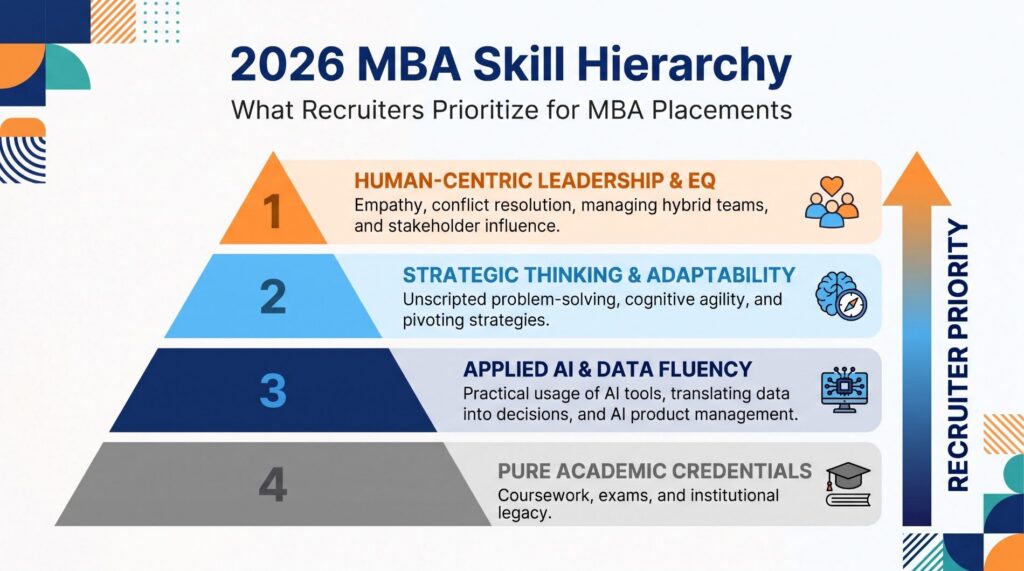
What Recruiters Actually Look For:
- Portfolio of Applied Work (Experiential Learning): Recruiters want to see proof of impact. They look for “applied portfolios”—evidence of live consulting projects, startup incubation, or real-world problem-solving during your MBA.
- Strategic Thinking & Adaptability: With market conditions changing faster than ever, the ability to analyze unscripted situations, pivot strategies, and show mental agility is ranked as the single most critical leadership skill.
- Human-Centric Leadership (The Non-Automated Gap): PwC’s Global Jobs Barometer highlights that while AI can automate data processing, it completely lacks empathy, emotional intelligence (EQ), and complex team leadership. Businesses are eagerly hiring MBAs who can manage diverse, often hybrid teams, navigate conflicts,and influence stakeholders without direct authority.
- Integrated Ethics & Governance: With the rise of data privacy laws and ESG (Environmental, Social, and Governance) mandates, employers highly value candidate readiness in risk, policy, and ethical decision-making.
4 Critical Parameters for Your MBA College Search
To ensure you choose a business school that puts you on the right side of these hiring patterns, adjust your shortlisting criteria around these four pillars:
1. Active Curriculum Evolution Check when the B-school last overhauled its syllabus. Have they introduced courses specifically addressing AI in business, data-driven decision-making, or sustainability management? Many institutions,including several IIMs, have launched dedicated AI, analytics, and digital business pathways. If a college’s brochure looks identical to its 2020 version, cross them off your list.
2. Live Projects vs. Static Internships Traditional 2-month summer internships, while still valuable, are no longer enough to guarantee top MBA placements 2026. Look for colleges that offer continuous experiential learning. Do they have cross-functional capstone projects, structured leadership labs, or partnerships with active businesses? A school with year-round “live corporate projects” gives you the real-world portfolio that recruiters seek.
3. Geographic & Corporate Hub Proximity Proximity to major industrial and tech hubs (like Delhi NCR, Mumbai,Pune, and Bengaluru) has a massive impact on your networking potential. Schools situated near these clusters can invite executive guest lecturers, host regular networking events, and connect students with part-time live projects much more effectively than isolated campuses.
4. Robust Alumni Placement Distribution An elite average salary figure can mask poor placements. During your research, inspect the diversity of the industries that hire from the campus. A healthy placement record should show balanced recruiting across Consulting, BFSI, Tech, Healthcare, and FMCG. Beware of schools where a single, volatile sector (like early-stage startups) accounts for more than 35% of the batch’s employment.
How to Conduct Your Modern B-School Shortlist
Ready to turn these insights into a personalized shortlist? Use this step-by-step strategy:
- Step 1: Check Modern Specializations. Identify your targeted career trajectory. If you want to work in finance or operations, look specifically at B-schools that offer highly integrated Business Analytics, FinTech, or Supply Chain Analytics tracks.
- Step 2: Connect with Class of 2024 & 2025 Alumni. Find recent graduates on LinkedIn. Ask them directly: Did recruiters ask about AI or digital skills during your placement interviews? Did you feel the coursework actually prepared you for your current job?
- Step 3: Look for Experiential Quality. Check the institute’s website and brochure for specific programs like leadership labs, hands-on client projects, or corporate mentorship initiatives.
Navigate Your MBA Journey with Angel Youth Education
Predicting MBA placements 2026 and finding the right campus is a demanding task. Navigating changing curriculums,checking the authenticity of corporate partnerships, and predicting which B-schools will give you the best launchpad requires expert insight.
At Angel Youth Education, our specialized College Compare and Search tool is built to help you look beyond the marketing noise. You can compare colleges side-by-side based on their specialization strengths, location advantages, and industry-readiness parameters.
Our admissions experts do not just look at ranking numbers—we analyze real corporate alignment, curriculum value, and the true ROI of every major Indian B-school.
Don’t make a blind investment in your future. Book a Free 1-on-1 Expert Counselling Session with Angel Youth Education today. Let’s identify the right, future-proof MBA or PGDM program that aligns perfectly with your percentiles,career goals, and the realities of the modern workforce.
Frequently Asked Questions (FAQs)
Q1. Are corporate recruiters still hiring MBAs in 2026? Yes, the demand remains highly robust. However, the nature of the roles has changed. Recruiters are shifting away from generalist management hires and are actively seeking candidates who understand digital workflows, apply AI to business problems, and can adapt rapidly to changing markets.
Q2. How is AI changing MBA placements 2026? Instead of eliminating MBA jobs, AI is redefining them. Basic analytics and reporting are automated, leaving human managers to focus on high-value strategic decision-making, cross-functional leadership, and client negotiation. Graduates with AI fluency and leadership capabilities are securing salary premiums.
Q3. How can I identify if a B-school’s curriculum is “future-ready”? Look for the presence of tech-integrated modules like Business Analytics, Digital Transformation, and AI application in the core syllabus. Avoid schools with outdated textbooks and look for those offering continuous live projects, capstone courses, and experiential leadership labs.
Q4. Does the location of an MBA college impact placements? Absolutely. Colleges located in or near major corporate and tech hubs (e.g., Delhi NCR, Bengaluru, Mumbai, Pune) offer vastly superior networking opportunities, frequent executive guest lectures, and direct access to live projects and internships, all of which are critical for securing high-value placements.