
Are you beginning your MBA college search for the 2026-27 academic cycle? With rising tuition fees and a constantly fluctuating corporate job market, choosing the right business school requires looking far past flashy brochures and legacy branding. Today’s MBA aspirant must act like an investor, and an investor never makes a multi-lakh rupee decision without analyzing the data.
In this comprehensive guide, we will break down exactly how to conduct a data-driven MBA college search. You will learn how to calculate true Return on Investment (ROI), decode confusing placement reports, understand hidden campus costs, and leverage 2026 hiring trends to secure your future. By the end of this article, you will have a clear, actionable framework for shortlisting B-schools that offer financial safety and excellent career growth.
Why the Traditional MBA College Search is Broken in 2026
Historically, a student’s MBA college search was simple: aim for the prestigious Indian Institutes of Management (IIMs),and if you missed the cut, filter down a list of private colleges based on who had the biggest campus. That era is over.
In 2026, the corporate hiring landscape is drastically different. Leading recruiters and multinational corporations are pivoting away from paying a premium just for a brand name. Instead, they are hiring candidates who possess specialized, future-proof skills—such as AI proficiency and data analytics. At the same time, the cost of top-tier education has skyrocketed. For example, the total flagship program fee for IIM Ahmedabad for the 2025-27 batch is now ₹27.50 Lakh (excluding personal expenses).
When you factor in an education loan at high interest rates, graduating without a massive debt burden becomes the most critical objective of your MBA college search. If you are currently preparing for CAT, XAT, MAT, or CMAT, your shortlisting strategy must be rooted purely in financial realities and objective placement data.
Decoding MBA Placements: Highest Package vs. Median Salary
The biggest mistake aspirants make during their MBA college search is being swayed by the “Highest International Package” marketed on a college’s website.
The “Highest Package” Trap
It is common to see mid-tier and elite business schools heavily advertise a ₹1.5 Crore+ or ₹50 Lakh+ international package. What the brochures do not tell you is that these outlier salaries are typically offered to just 1% to 2% of the batch. Furthermore, these candidates often enter the MBA program with highly specific, specialized prior work experience (such as 4 years in offshore IT product management) that perfectly matches the recruiter’s exact requirement.
Basing your college selection on the highest package is like buying a lottery ticket—it does not represent the realistic outcome for the average student.
Why Median Salary is the Only Metric You Should Trust
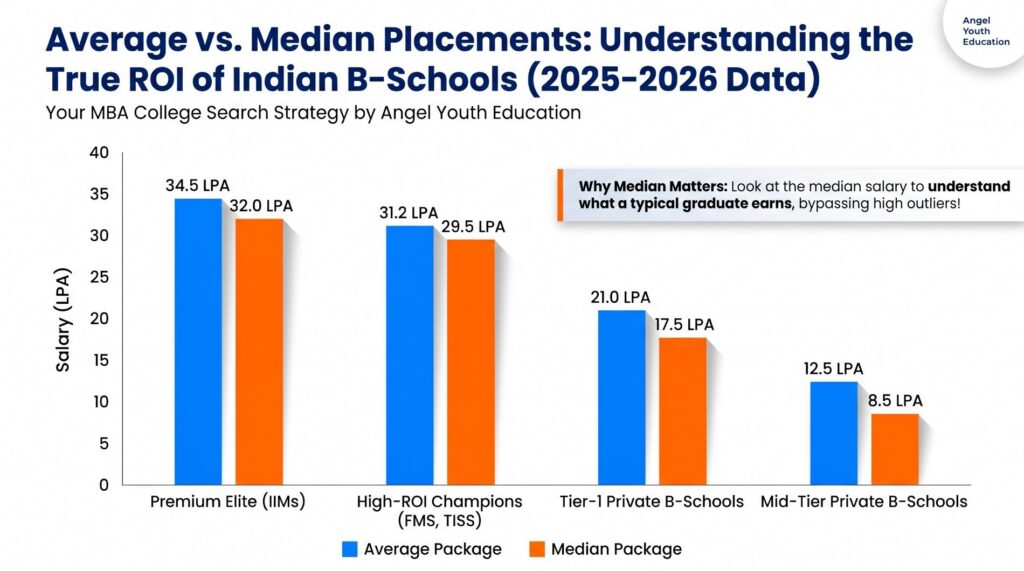
To conduct a highly efficient MBA college search, you must ignore the highest package and even be skeptical of the average salary. Averages can be severely skewed upward by a handful of massive international offers.
Instead, look exclusively at the Median Salary. The median represents the exact midpoint of the graduating batch. If a B-school claims an average package of ₹20 Lakh, but the median is ₹14 Lakh, it tells you a vital truth: exactly 50% of the graduating students are earning ₹14 Lakh or less. The median is the safest, most accurate reflection of what a standard,fresh-faced student will earn upon graduation.
Always cross-reference institutional placement reports with independent audits and alumni interactions on professional networks like LinkedIn.
The Formula for True MBA ROI: Uncovering Hidden Costs
A successful MBA college search hinges on one core concept: True Return on Investment (ROI). Many students calculate ROI simply by dividing their expected salary by the college’s stated tuition fee. This is fundamentally flawed because it ignores the hidden and economic costs of pursuing a two-year degree.
Breaking Down the Real Cost of an MBA
To calculate the true cost of your degree, you must combine three factors:
- Tuition & Academic Fees: The baseline advertised cost of the program (e.g., ₹15 Lakh to ₹28 Lakh).
- Hostel & Living Expenses: Often excluded from the “tuition fee,” boarding and lodging can add ₹3 Lakh to ₹5 Lakh over two years, especially if the campus is located in tier-1 cities like Mumbai, Bengaluru, or Delhi NCR.
- Opportunity Cost (Salary Forgone): This is the most crucial, yet most ignored, hidden cost. If you are currently working and earning ₹8 Lakh per year, leaving your job for a 2-year MBA means you are sacrificing ₹16 Lakh in gross earnings.
How to Calculate Your Payback Period
Let us assume College X has a tuition fee of ₹20 Lakh and living expenses of ₹4 Lakh. You are leaving a job that pays ₹7 Lakh annually (₹14 Lakh opportunity cost).
- Total Investment: ₹20L + ₹4L + ₹14L = ₹38 Lakh
- Post-MBA Median Salary: ₹18 Lakh
In this scenario, assuming taxes and living expenses, it will take you over three years of your entire gross income to break even on the MBA. A highly efficient MBA college search aims to find institutions where the payback period is restricted to 18 to 24 months.
ROI Champions vs. The Elite: 2026 Fee and Placement Realities
As you finalize your shortlist, it helps to understand how different tiers of colleges perform on the true ROI scale based on the latest 2026 data.
The High-ROI Champions
Institutions like the Faculty of Management Studies (FMS) Delhi, TISS Mumbai, and specific IIT management programs offer the highest ROI multiples in the country. For example, the FMS Delhi MBA fee for the 2026-28 batch is an incredibly low ₹2,43,272 for the entire two-year program. Despite this minimal cost, FMS frequently reports average placement packages exceeding ₹30 Lakh. The payback period for colleges in this category is often less than six months,making them the ultimate prize in any MBA college search.
The Premium Elite (IIM A, B, C, and ISB)
The top-tier institutions charge a massive premium. As mentioned earlier, IIM Ahmedabad’s program fee is ₹27.50 Lakh.However, they justify this cost with pristine placement records—IIM Ahmedabad’s 2026 median salary stands around ₹32 Lakh, with 100% placements. While the financial investment is steep, the real ROI here is the unmatched global alumni network and direct access to top-tier global consulting (McKinsey, BCG) and investment banking roles that are simply unavailable elsewhere.
The Mid-Tier Danger Zone
During your MBA college search, be highly critical of private B-schools that charge ₹16 Lakh to ₹20 Lakh in tuition fees but deliver median salaries of only ₹7 Lakh to ₹9 Lakh. Taking a massive educational loan for a sub-₹10 Lakh package will severely restrict your financial freedom, preventing you from making major life investments in your late 20s and early 30s.
Emerging 2026 MBA Hiring Trends You Cannot Ignore
Your MBA college search should not just look at past data; it must anticipate the future. According to 2026 placement trends, the skills you acquire are becoming just as important as the college brand name.
- The AI Salary Premium: AI is rapidly reshaping corporate hiring. Students who demonstrate proficiency in applying AI tools to business strategy, financial modeling, or supply chain management are receiving 20% to 35% higher salary offers than their peers.
- Sector Resurgence: After the startup funding winters of recent years, traditional recruiters in Management Consulting, Banking (BFSI), and FMCG have significantly increased their MBA intake.
- Rise of Specializations: General MBAs are losing ground to specialized fields. Business Analytics, ESG (Environmental, Social, and Governance), and technology management programs are seeing aggressive hiring and vastly improved ROI metrics. When conducting your MBA college search, prioritize colleges with updated, tech-integrated curriculums.
[Image Placeholder: Infographic showing the 2026 MBA hiring trends by sector. Alt Text: Sector-wise hiring trends and AI salary premiums affecting the MBA college search]
Step-by-Step MBA College Search Strategy for 2026
To execute a flawless, data-driven MBA college search, follow this exact framework:
- Map Your Budget & Opportunity Cost: Determine your maximum budget and calculate the salary you will lose over two years. Set a hard limit on the education loan you are willing to take.
- Filter by Realistic Exam Percentiles: Be brutally honest about your CAT, XAT, or MAT mock scores. Build three lists: Dream Colleges, Realistic Targets, and Safe Backups.
- Analyze the Median, Not the Average: Dig into the placement reports of your shortlisted colleges. Strip away the top 10% of offers and look strictly at the median figures.
- Verify via Alumni: Do not trust brochures alone. Use LinkedIn to connect with recent alumni (graduated in 2024 or 2025). Ask them about the reality of the campus placement cell, hidden hostel fees, and the quality of companies visiting the campus.
- Check the Corporate Tie-ups: Look for colleges that have active industry incubation centers, live corporate projects, and strong geographic advantages (e.g., proximity to corporate hubs like Gurugram, Pune, or Bengaluru).
Simplify Your MBA College Search with Angel Youth Education
Navigating complex fee structures, verifying placement reports, and calculating true ROI can be overwhelming for a busy student preparing for competitive exams. You do not have to do it alone.
At Angel Youth Education, our proprietary College Compare and Search tool allows you to instantly stack up your target B-schools side-by-side. We bypass the marketing fluff to show you verified institutional data, hidden hostel fees,and accurate median salary metrics.
Ready to find an MBA program that guarantees a high return on your investment? Do not guess with your career or your finances. Book a Free 1-on-1 Expert Counselling Session with Angel Youth Education today. Our seasoned admission experts will help you conduct a personalized MBA college search, shortlisting high-ROI colleges perfectly matched to your budget, academic profile, and entrance exam percentiles.
Frequently Asked Questions (FAQs)
Q1. What is the most important factor in an MBA college search? While curriculum and faculty are important, the most critical factors are the True ROI and the median post-MBA salary. Ensure that the total cost of the program aligns with realistic earnings so you can pay off any educational loans within two to three years.
Q2. How is True MBA ROI calculated? True ROI is calculated by taking your projected median post-MBA salary and dividing it by the total cost of the program. Remember that the total cost includes tuition, hostel and living expenses, and the opportunity cost (the salary you gave up to study for two years).
Q3. Why should I look at median placements instead of average placements? Average placements can be falsely inflated by a few exceptionally high salary packages (such as international offers). The median placement shows the exact middle salary of the batch, giving you a highly accurate picture of what the average student will earn.
Q4. Which colleges offer the best ROI for MBA in India in 2026? Institutions with highly subsidized fee structures,such as FMS Delhi, TISS Mumbai, and the management departments of elite IITs (like IIT Delhi DMS and SJMSOM IIT Bombay), consistently offer the best ROI in the country, often boasting payback periods of less than a year.